

In Singapore’s commercial landscape, vendors often issue a Letter of Demand (LOD) as a first step to recover unpaid debts when a debtor company falters. While effective as a pre-insolvency pressure tool, the LOD loses its coercive power and does not elevate the vendor’s priority in repayment once the company enters liquidation under the Insolvency, Restructuring and Dissolution Act 2018 (IRDA). Crucially, an LOD does not confer priority, security or enhanced recovery rights – leaving vendors exposed as unsecured creditors in a crowded liquidation queue.
1. Pre-Liquidation Role of the LOD
An LOD serves as a formal demand for payment, typically within 7–14 days. Under Section 125(2)(a) IRDA, if a debt over SGD15,000 remains unpaid three weeks after service, it deems the company unable to pay its debts, enabling a winding-up petition. It proves the debt and may prompt settlement, but creates no security or priority—vendors remain ordinary unsecured creditors.
2. Post-Liquidation Limitations
An LOD serves as a formal demand for payment, typically within 7–14 days. Under Section 125(2)(a) IRDA, if a debt over SGD15,000 remains unpaid three weeks after service, it deems the company unable to pay its debts, enabling a winding-up petition. It proves the debt and may prompt settlement, but creates no security or priority—vendors remain ordinary unsecured creditors.
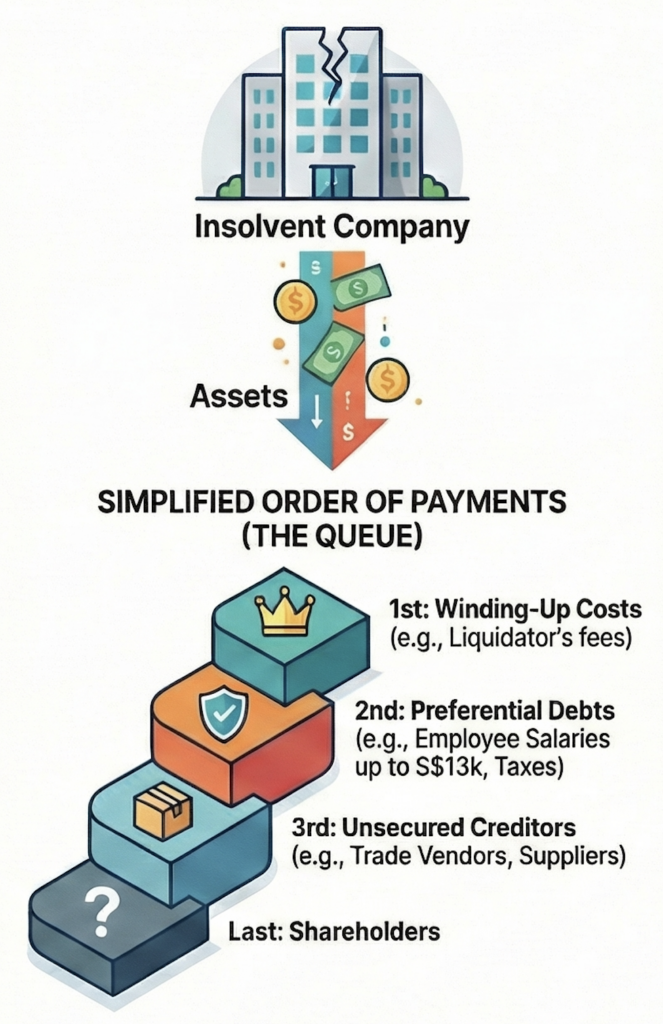
3. Creditor Hierarchy Under Section 203 IRDA
- Secured creditors (fixed charges) enforce outside the process.
- Liquidation costs and expenses.
- Preferential debts (e.g., employee wages/salaries up to S$13,000, retrenchment benefits, CPF contributions, taxes/GST).
- Unsecured creditors (including trade vendors), ranking equally—often recovering little or nothing.
- Shareholders (surplus only).
In many cases, funds are exhausted before unsecured creditors receive anything, leaving vendors with minimal or no recovery.
4. Strategies to Improve Recovery
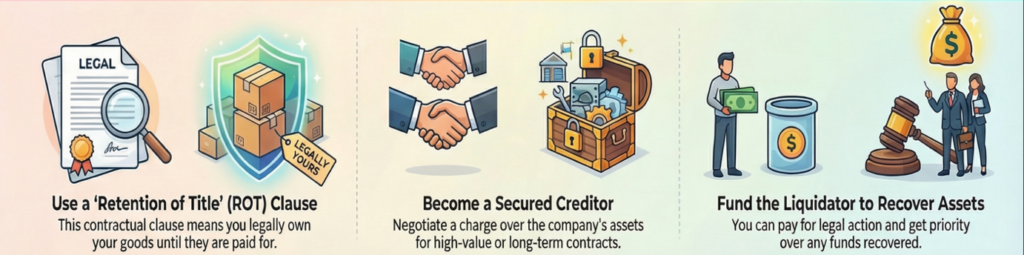
- Retention of Title (ROT) Clauses — Well-drafted clauses retain ownership of goods until payment, allowing repossession (excluding them from the estate). Effectiveness depends on drafting; risks arise if goods are mixed or resold.
- Taking Security — For large or ongoing contracts, vendors may negotiate a secured interest over assets.
- Funding Liquidator Actions — Under Section 204 IRDA, creditors can indemnify costs for challenging voidable transactions. Courts may grant priority over recovered assets, enabling near-full recovery from proceeds.
5. Conclusion
While an LOD is valuable pre-liquidation, it offers no advantage post-commencement. Vendors typically endure low recovery as unsecured creditors. Proactive measures—like ROT clauses or funding litigation—can significantly mitigate risks and enhance prospects under Singapore’s insolvency regime.